The Big One: What Happens When Cascadia’s Megaquake Hits
Plus, why you need a 2-week plan, not just 3 days.

written by
Jordan Hanson
October 23, 2026

The Fault That’s Overdue
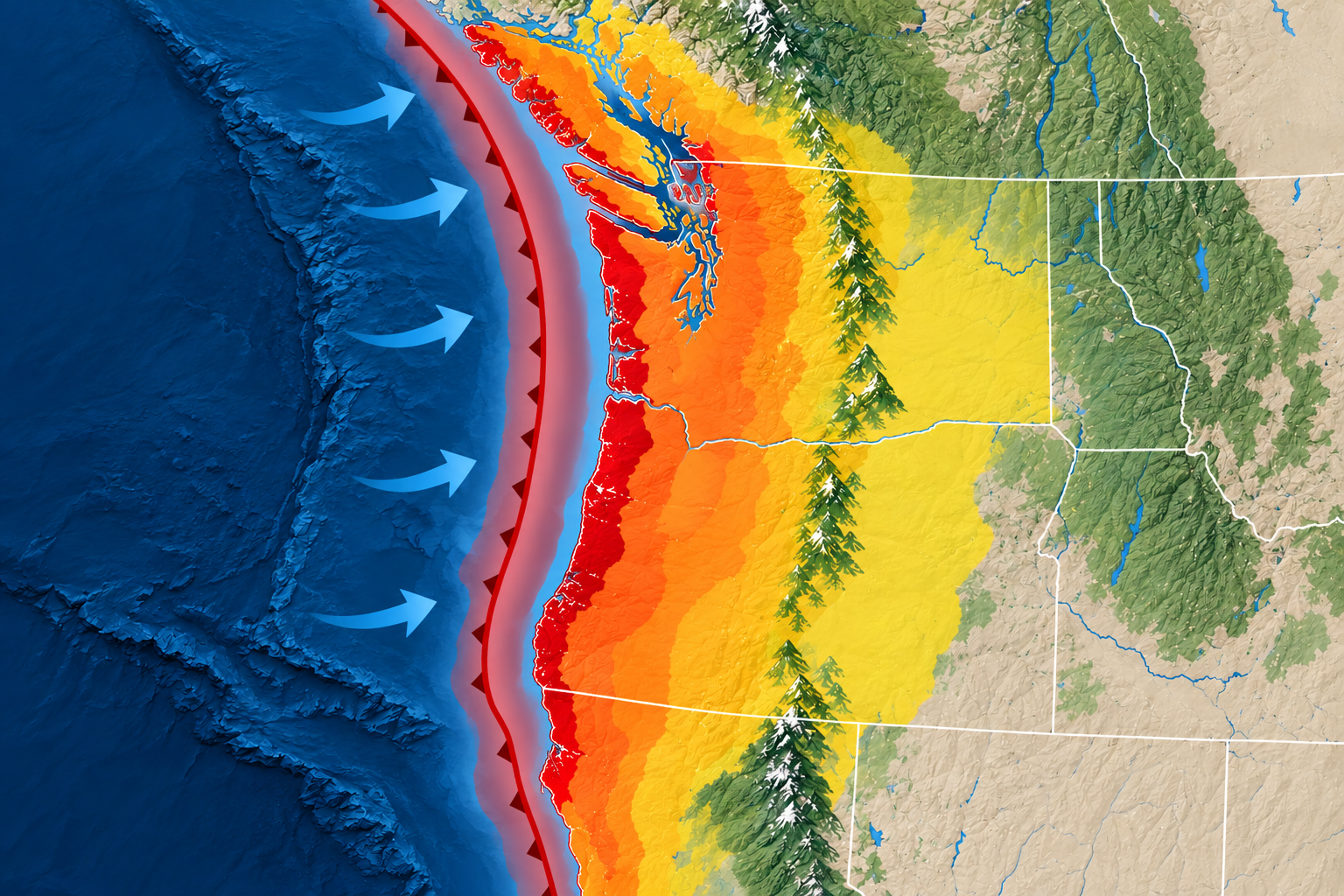
Somewhere off the coast of the Pacific Northwest, roughly 70 to 100 miles out, a fault line hundreds of miles long is locked and loading pressure it will eventually release all at once. Geologists call it the Cascadia Subduction Zone, and it last ruptured in full on January 26, 1700, 326 years ago. The interval between its largest earthquakes averages somewhere between 240 and 550 years, depending on which dataset you trust, which means by the numbers, the region is due, or overdue, for a repeat. This isn't speculation: it's established seismology that shapes building codes, school drills, and disaster planning from Vancouver Island to Northern California. Here's what the science says about the earthquake Pacific Northwesterners call "the Big One", and what life would look like in the minutes, days, and months after it hits.
What the Cascadia Subduction Zone Actually Is
The Cascadia Subduction Zone is a roughly 600-mile-long boundary running from northern Vancouver Island down through Washington and Oregon to Cape Mendocino in Northern California. There, the Juan de Fuca tectonic plate (a slab of ocean floor smaller than Nevada) slides beneath the much larger North American plate at about the rate fingernails grow. Most of the time, the two plates don't slide smoothly: friction locks them together, so the edge of North America gets dragged down and compressed, storing centuries of strain like a bent diving board.
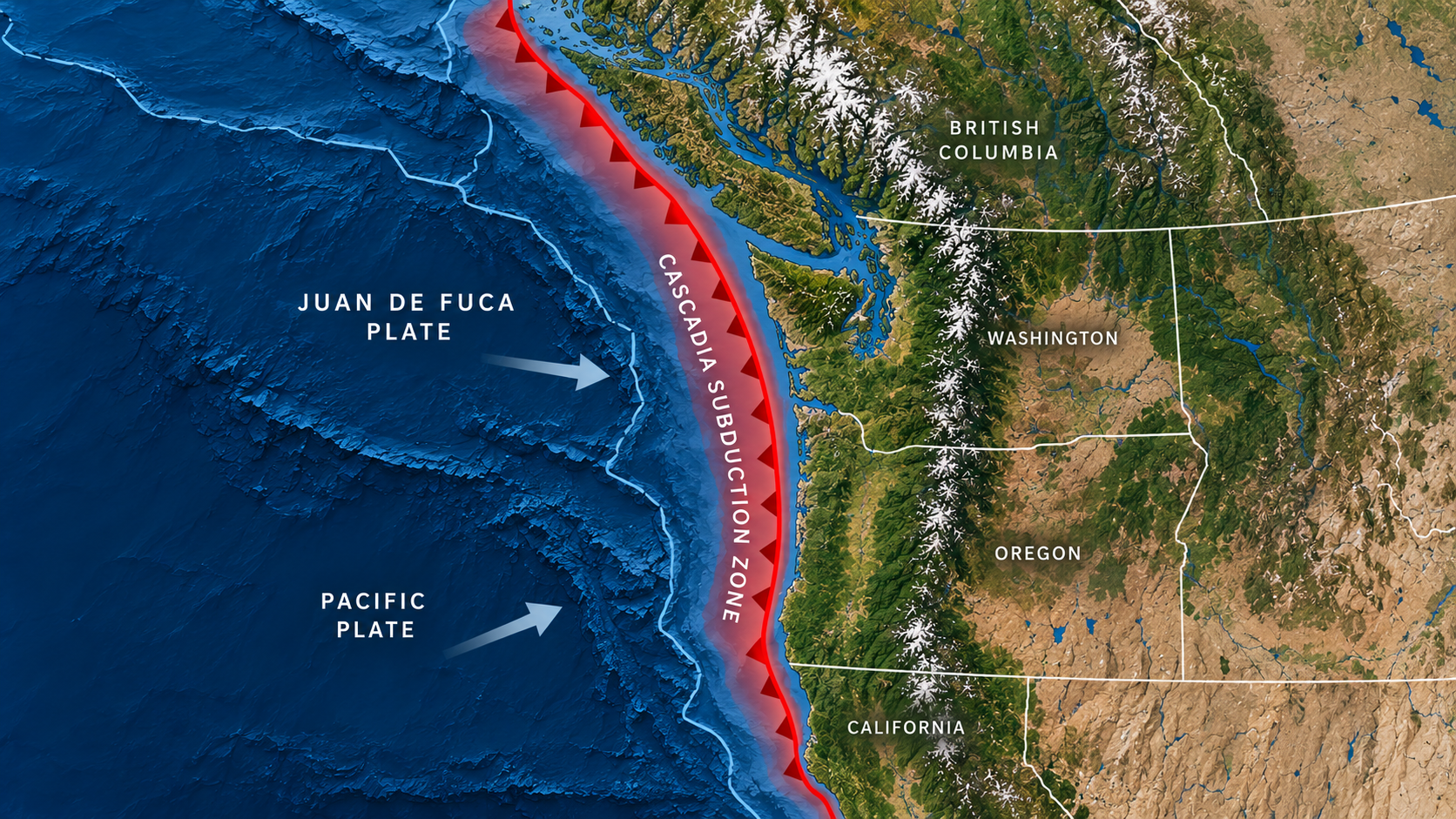
When the fault finally slips, it doesn't creep; it snaps, releasing hundreds of years of accumulated energy in a matter of minutes. That's what produces a megathrust earthquake, the same category of event behind the 2004 Indian Ocean earthquake and the 2011 Tohoku earthquake in Japan. A full-margin Cascadia rupture is expected to register magnitude 8.7 to 9.2, with the possibility of smaller (though still devastating) M8-class quakes that break only part of the fault, typically its southern end off the Oregon coast.
What the Shaking Itself Would Feel Like
A full-margin rupture today would produce violent shaking lasting four to six minutes across a huge swath of the region from southern British Columbia through Washington and Oregon into Northern California. It won’t be the 15 to 30 seconds most people associate with a bad earthquake. Structures that could survive a short, sharp jolt can fail under that much sustained shaking.
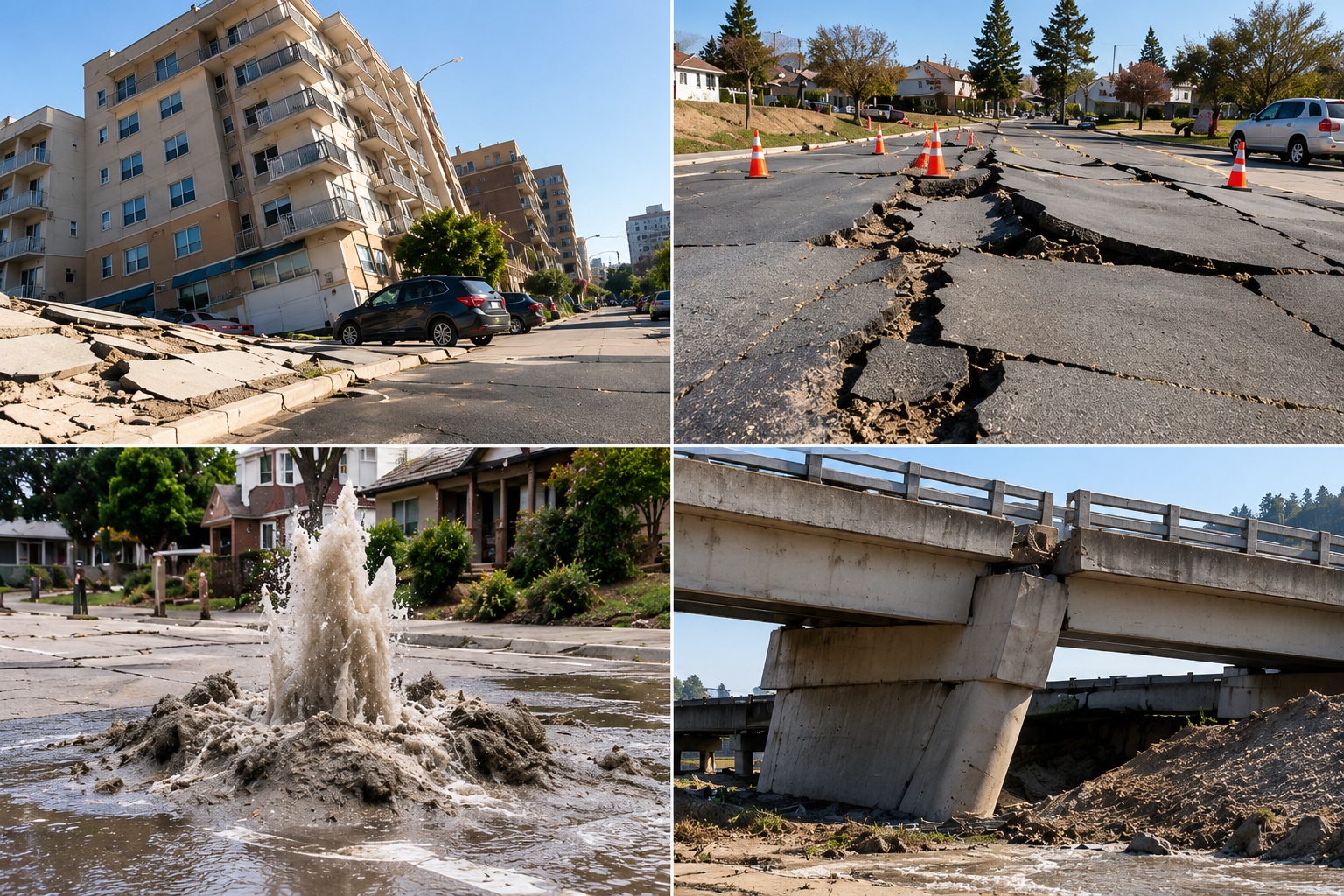
The intensity wouldn't be uniform. Areas built on soft, water-saturated soil (river deltas, fill land, and some waterfront neighborhoods in Seattle, Tacoma, and Portland) are vulnerable to liquefaction, where shaking temporarily turns solid-seeming ground into something closer to quicksand, causing buildings, roads, and pipelines to sink, tilt, or rupture. Coastal communities closest to the fault would experience the most violent shaking, which generally weakens with distance inland, though a 2022 University of Washington modeling study found that the deep, soft sediment under cities like Seattle might absorb some of the highest-intensity shaking rather than amplify it, one of the few relatively good pieces of news in the forecast.
The Tsunami: Minutes, Not Hours, of Warning
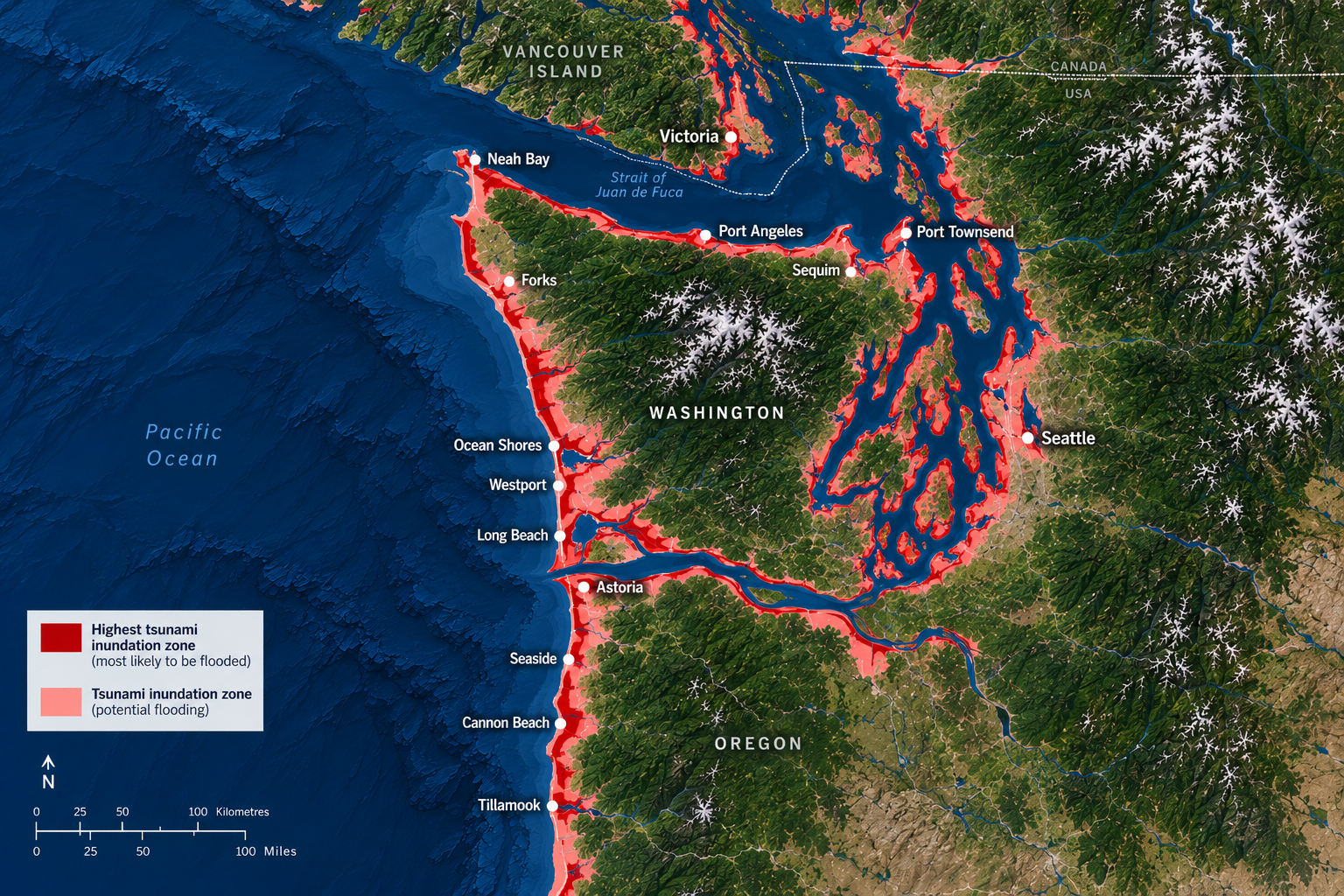
For coastal communities, the earthquake and the tsunami are effectively the same event: there's no time for a conventional warning system. Emergency officials put it bluntly: the shaking itself is the warning. Once the ground stops moving, residents are told to move immediately to high ground without waiting for official word.
Modeling by Oregon's Department of Geology and Mineral Industries suggests waves could reach Gold Beach in as little as 10 minutes after the quake begins, with Seaside seeing wave arrival in 20 to 22 minutes and flooding starting around 30 to 34 minutes in. On the Washington side, Department of Natural Resources simulations show waves over 10 feet hitting the Olympic Peninsula coast within about 15 minutes, reaching Port Angeles in roughly 50 minutes and Port Townsend within 90, with waves of 10 feet or higher continuing to strike for hours afterward. Low-lying coastal towns without quick access to higher ground (much of the Long Beach Peninsula and Oregon's beach communities among them) are considered the highest-risk zones in the region.
Roads, Bridges, and the Lifelines That Break
Transportation is one of the biggest vulnerabilities. Coastal highways like U.S. 101 and the bridges that cross coastal rivers are expected to suffer heavy damage, potentially isolating entire communities for weeks or months where alternate routes don't exist. Further inland, the picture is more mixed: 2022 modeling done by the University of Washington for the state's Department of Transportation found that most bridges along the I-5 corridor through major cities are likely to remain standing and usable, since shaking weakens with distance from the fault and many Northwest highway bridges were built above minimum seismic standards. Still, planners generally assume some elevated sections (like Seattle's I-5 stretch from Boeing Field to Lake City Way) will be out of service, and that study didn't account for landslides, retaining wall failures, or liquefaction, any of which could block roads even where the bridges themselves survive.
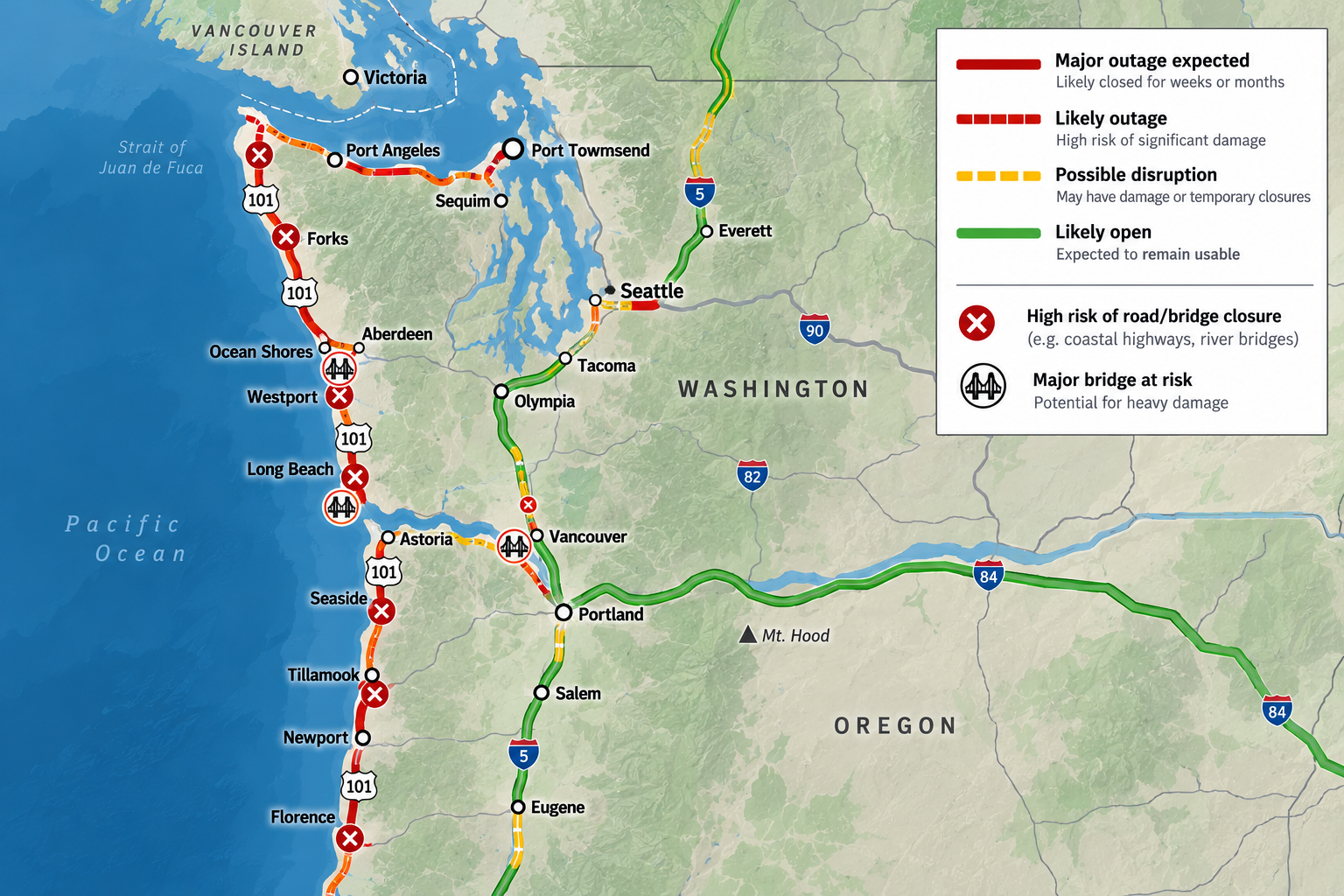
Ports and airports face their own risks: runways and terminal facilities near the coast could suffer damage running into the hundreds of millions of dollars to repair, complicating the arrival of outside aid. Power grids, water mains, and fuel pipelines are all considered lifelines at serious risk of being severed, and officials are candid that some of these systems could be down for months, not days, with power potentially restored in isolated "islands" long before the full grid is back online.
The Human Toll and How Long Recovery Could Take
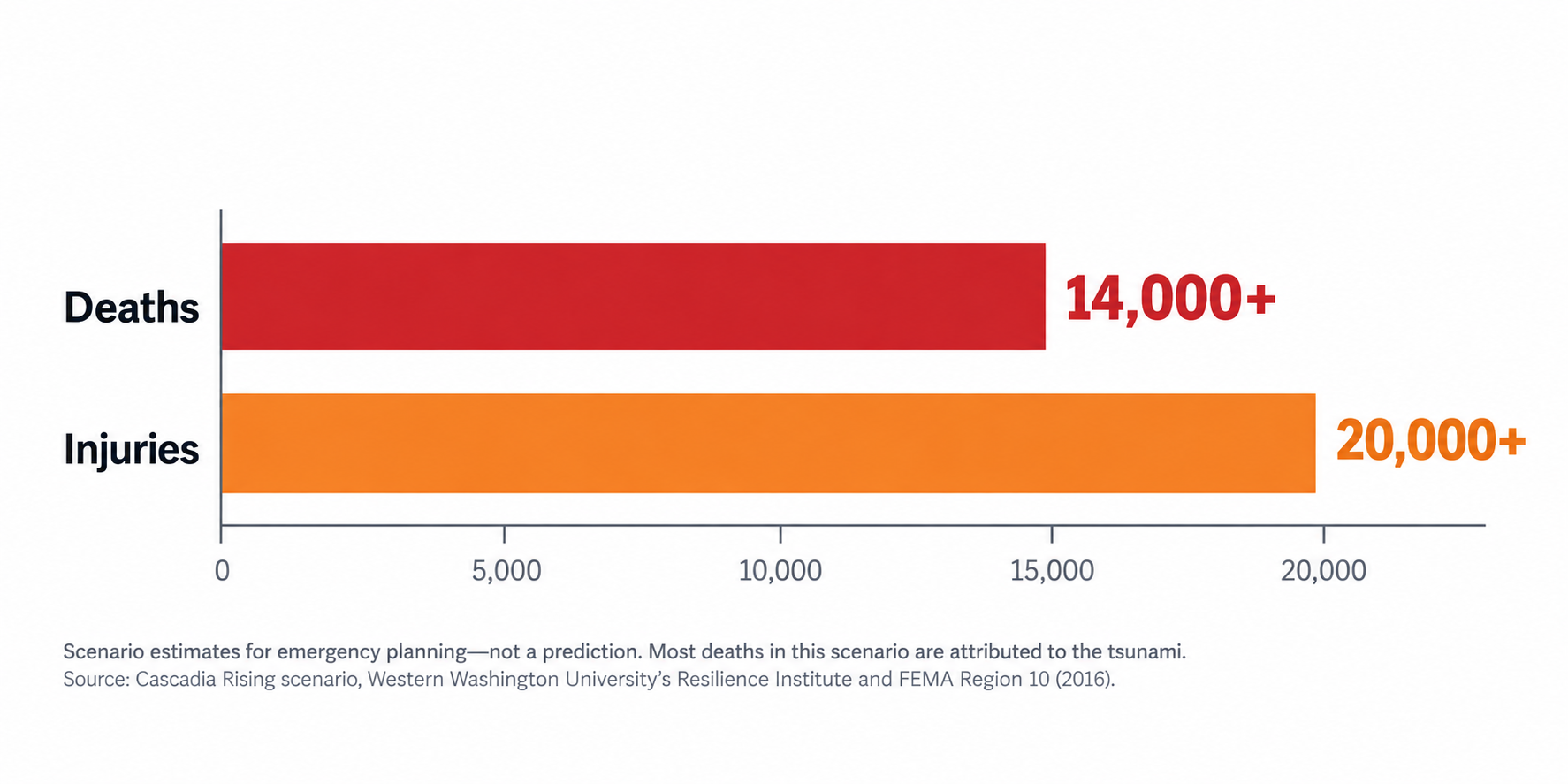
The most widely cited casualty estimates come from Cascadia Rising, a scenario developed by Western Washington University's Resilience Institute with FEMA Region 10 ahead of a 2016 multi-state emergency exercise. That scenario projects more than 14,000 deaths and more than 20,000 injuries across Washington and Oregon, with most fatalities caused by the tsunami rather than the shaking itself. In the scenario, Interstate 5 is heavily damaged, hospitals are overwhelmed or forced to evacuate, and power is out for days to months depending on location.
Outside emergency responders could take weeks, if not months, to reach some areas, and the responders and supplies that do arrive may be competing with widespread damage to the ports, airports, and highways they'd normally use to get there. This is the reasoning behind Pacific Northwest emergency guidance urging two weeks of self-sufficiency, rather than the three-day kit recommended elsewhere in the U.S.: for at least the first several days to two weeks, hard-hit communities (particularly coastal ones cut off by damaged roads) will largely be on their own.
What You Can Actually Do About It
None of this is meant to be paralyzing: it's meant to be actionable. A few things emergency planners consistently recommend for anyone living in the region:
- Know your zone. If you live, work, or travel near the coast, learn whether you're in a tsunami inundation zone and identify your nearest high ground or vertical evacuation structure before you need it
- Build a two-week kit, not a three-day one. Regional guidance assumes help may be delayed well beyond the national standard: water, food, medications, a battery or hand-crank radio, and cash are the basics.
- Secure your space. Strapping down water heaters, bookcases, and other heavy furniture reduces injury risk during the several minutes of shaking a full-margin quake would bring.
- Make a family communication plan. Phone networks are likely to be overwhelmed or down; agree in advance on an out-of-area contact and a meeting point.
- Retrofit if you can. Older homes not bolted to their foundations and unreinforced masonry buildings are especially vulnerable; seismic retrofits are one of the few things individuals and building owners can do to directly change the outcome.
The Cascadia Subduction Zone isn't a hypothetical. It's a known, mapped, well-studied fault that has done this before and will do it again; the only open questions are when, and how ready the region will be.
Sources
- PNSN: What is the Cascadia Subduction Zone and when is the next Big One going to hit?
- Scientific American: Risk of giant quake off American west coast goes up
- FOX Weather: 9.0 quake rocked the Pacific Coast 324 years ago and sent an "orphan tsunami" to Japan
- USGS: The Orphan Tsunami of 1700 — Japanese Clues to a Parent Earthquake in North America
- Eugene Weekly: Wave of Warning
- Peninsula Daily News: Newest tsunami models show huge waves battering Peninsula coasts
- OPB: Some freeways may be usable following 'the Big One' per new modeling by UW
- WWU News: Next major PNW earthquake could kill 14,000, research shows
- KGW: Help after a Pacific Northwest earthquake could take weeks, if not months
- Hoodline: Portland quake pros sound alarm as lifelines look ready to snap in 'Big One'
*Images are for demonstrative purposes only, not official reports
Prepare Medical keeps medications in your house when you need them most.

Disclaimer: All prescriptions are subject to physician review and approval. Medications are dispensed only through licensed Canadian pharmacies in compliance with Health Canada regulations. Telehealth access is included as part of your program and is not intended as a substitute for emergency medical services. Always seek immediate care in life-threatening situations.